

How it works
The original is kept. Everything else is built on top.
RivetHub does four things with what your agents do: it captures the whole session, makes it searchable, organizes it into something a person can read, and serves it back to you and to any agent.
Capture: the whole session, from each tool's own hook
Each tool calls rh capture hook from its own hook system. The hook reads the tool's transcript and posts new prompts, replies, tool calls and tool results to your node. It always exits cleanly, so a capture problem never blocks your session; if the node is down, the batch is spooled to disk and sent on the next run.
| Tool | Captures on | Reads |
|---|---|---|
| Claude Code | UserPromptSubmit, PostToolUse, Stop, SubagentStop, SessionEnd | the session transcript |
| Codex | Stop, SessionEnd | ~/.codex/sessions |
| Grok Build | Stop, PreCompact, SessionEnd | ~/.grok |
| OpenCode | session.idle, session.error, from an OpenCode plug-in | ~/.local/share/opencode/opencode.db |
| DeepSeek Harness | turn/end, from a dsh plug-in | ~/.dsh |
rh harness connect <tool> does the wiring. Turn on memory.capture.redaction in ~/.rivethub/config.yaml to strip secrets before anything is stored; it is off by default. RivetHub's own model calls are never captured as sessions.
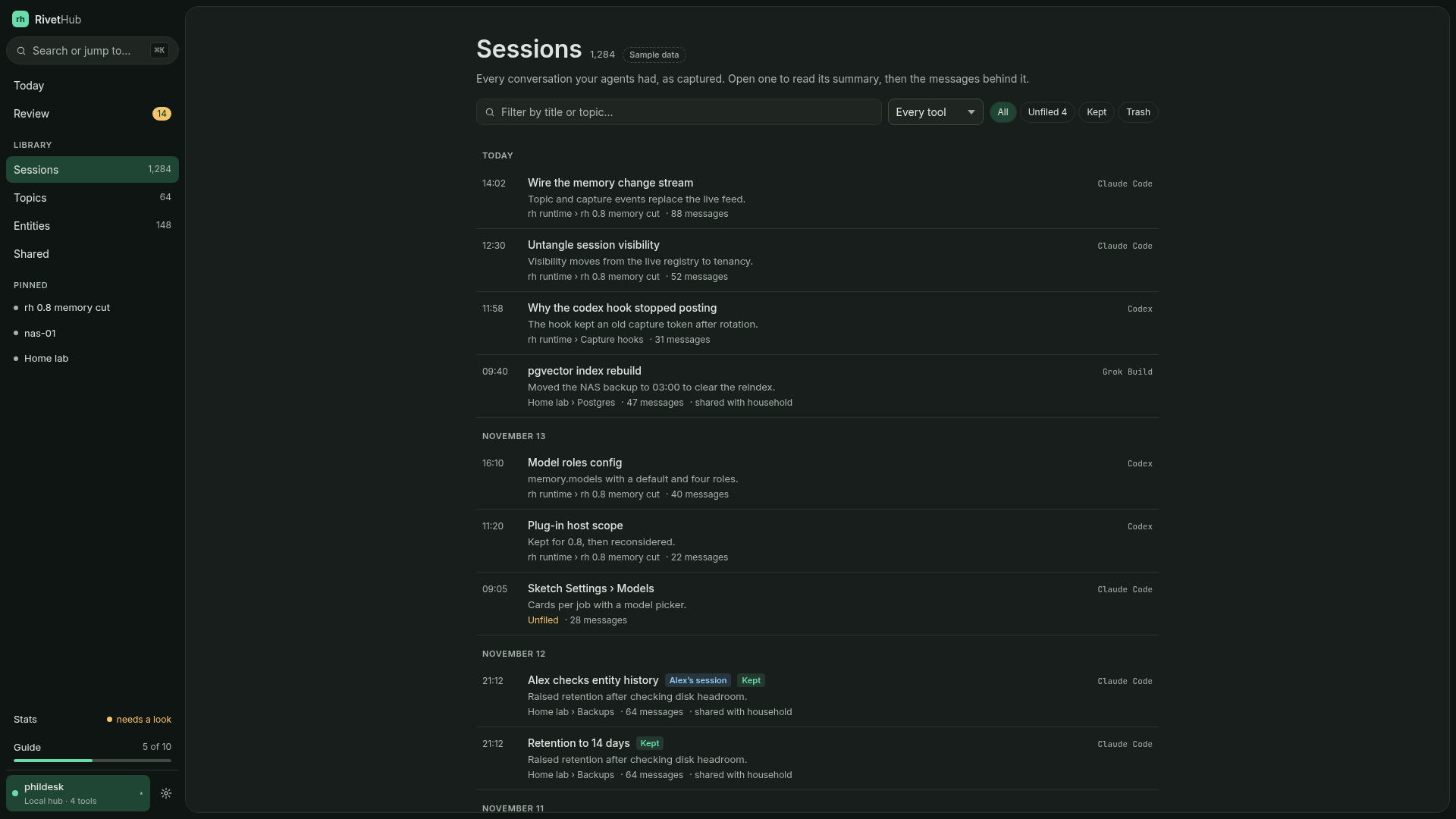
Search: every hit opens the real exchange
Search ranks messages, message chunks and summaries together, blending keyword match, fuzzy (trigram) match, vector similarity and recency. You can ask for one mode on its own, including regex, and narrow by date.
Keyword search works with no model at all, and labels results as keyword-only. Add an embedding endpoint and the embedder backfills what is already stored, so older sessions become searchable by meaning too.
Summaries: a tree over each session, never a replacement
When a session goes idle, the summarizer writes a tree of summaries over it: leaves over stretches of the conversation, branches over leaves, one root over the whole. Long sessions stay readable, search can match an idea rather than an exact phrase, and an agent can read a session one level at a time.
The captured messages stay exactly as they were. A summary hit expands back to the messages it was written from.
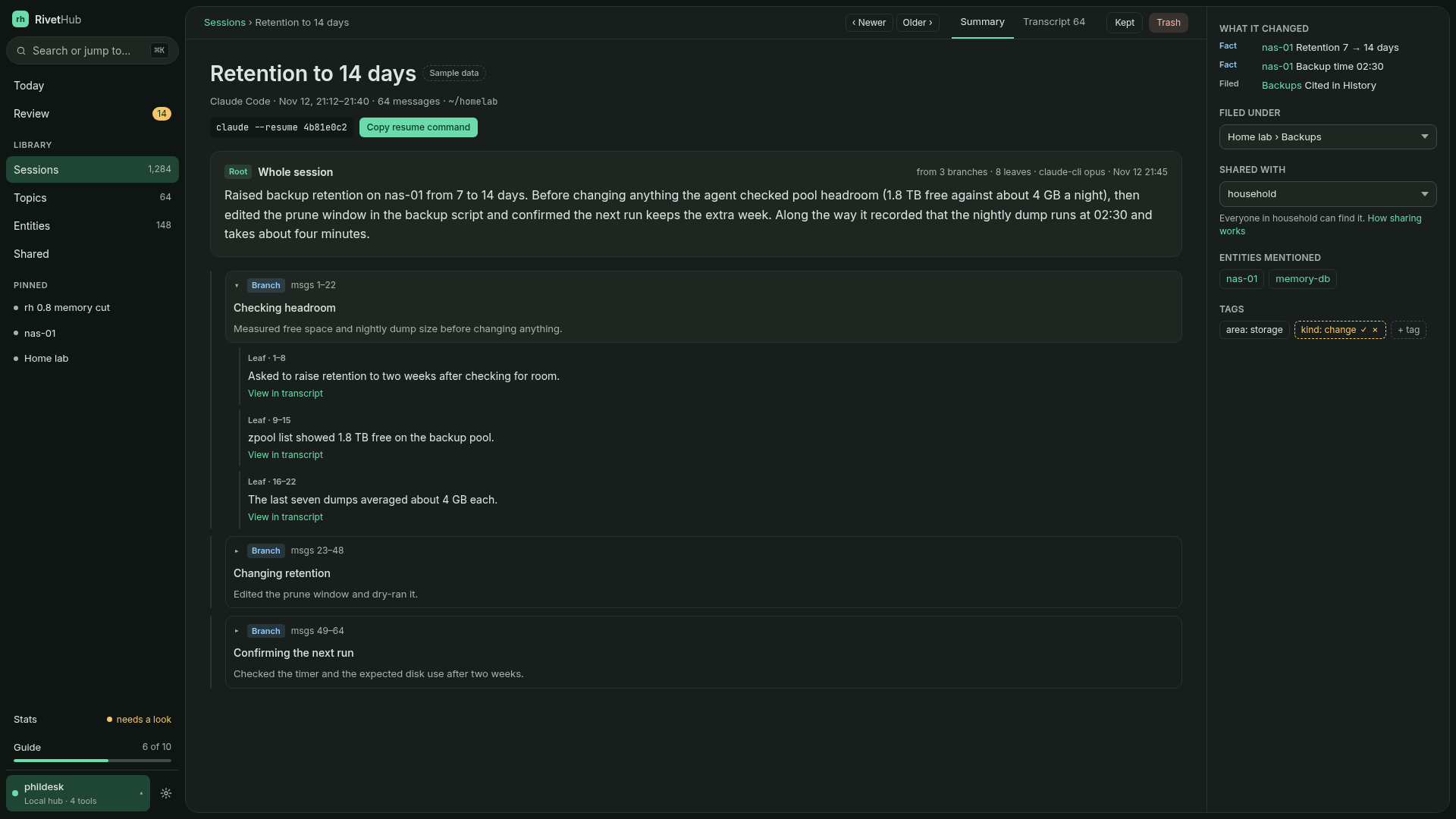
Topics and decisions: work filed where it belongs
Sessions are filed into work topics, nested up to four levels. File a session yourself, or let the categorizer do it; it never overrides a placement you made. Each topic carries its decisions: short, dated statements of what was agreed.
The people, hosts, services, repositories and models your work mentions become entities, with pages of their own, kept apart from the work tree.
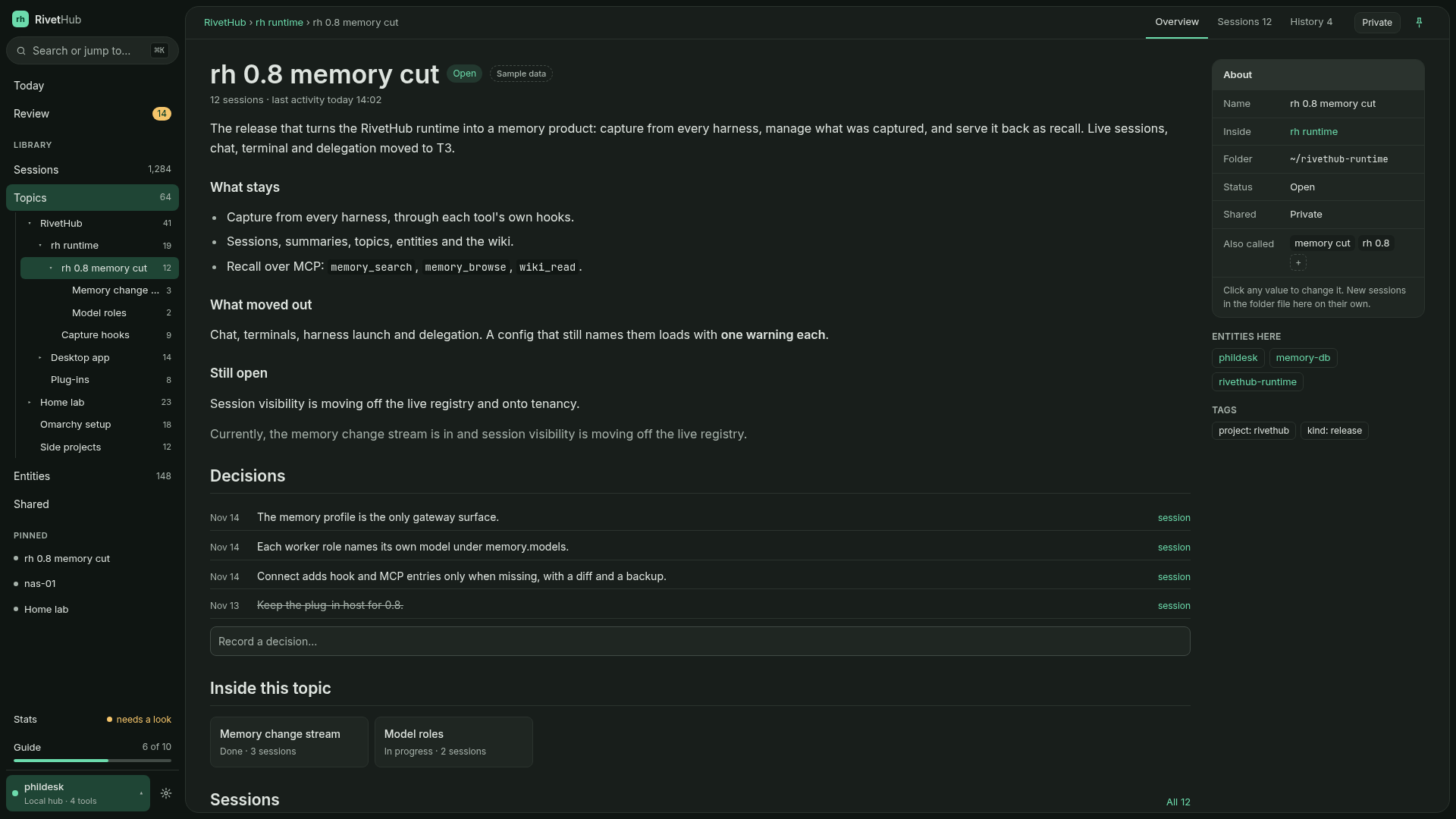
Wiki: what is currently true, rewritten rather than piled up
The wiki builder reads each new summary and updates the pages it concerns: one page per root topic and one per entity. A page is rewritten within a fixed size budget, so it stays current instead of growing forever. Whatever a rewrite drops is archived, not lost.
On a standalone node, pages are written as plain Markdown files under wiki_dir (for example ~/.rivethub/wiki). On a Postgres datahub, each scope is a Git repository you can clone, read and diff. Agents read the wiki with wiki_search and wiki_read.
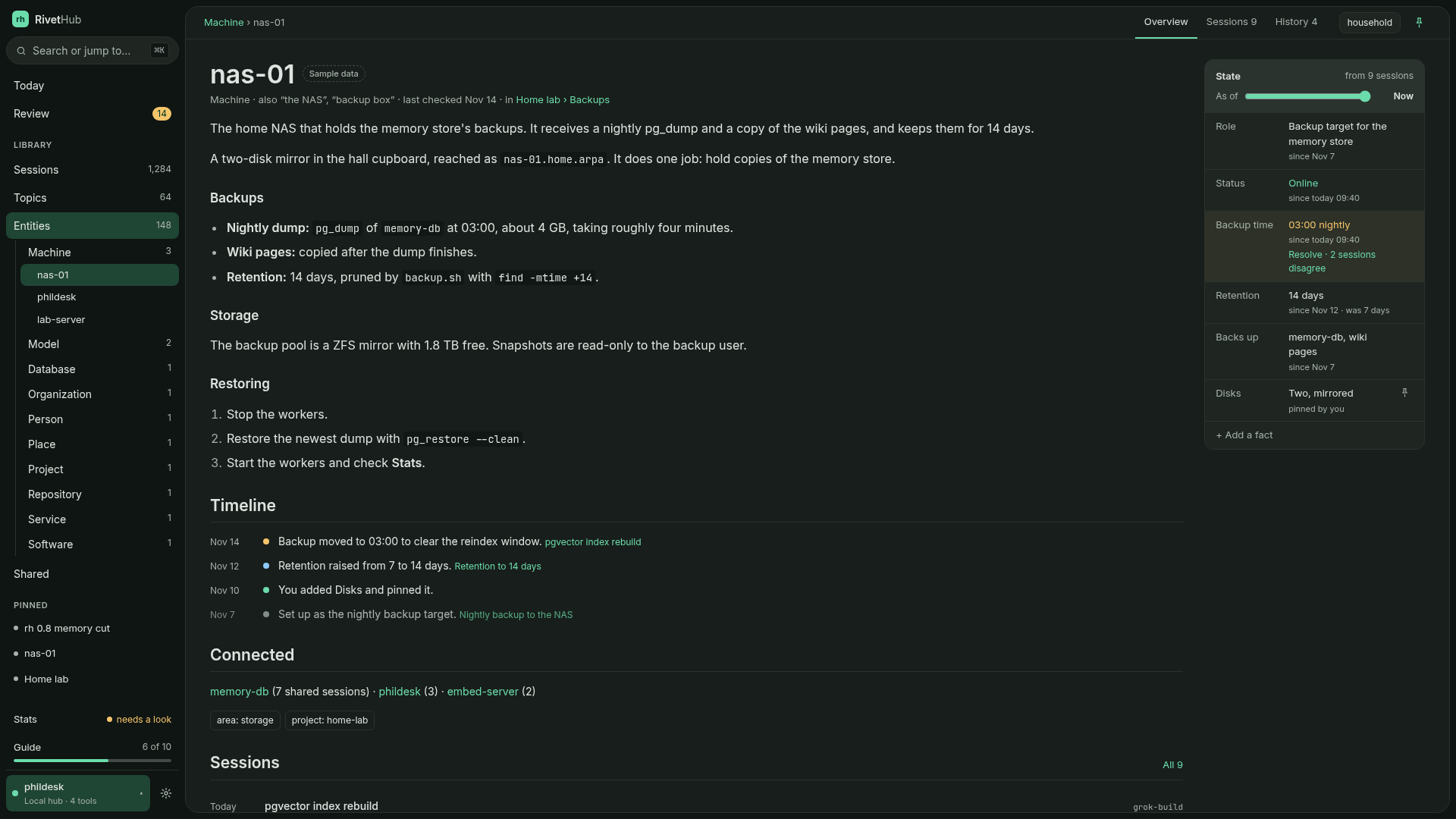
You approve changes
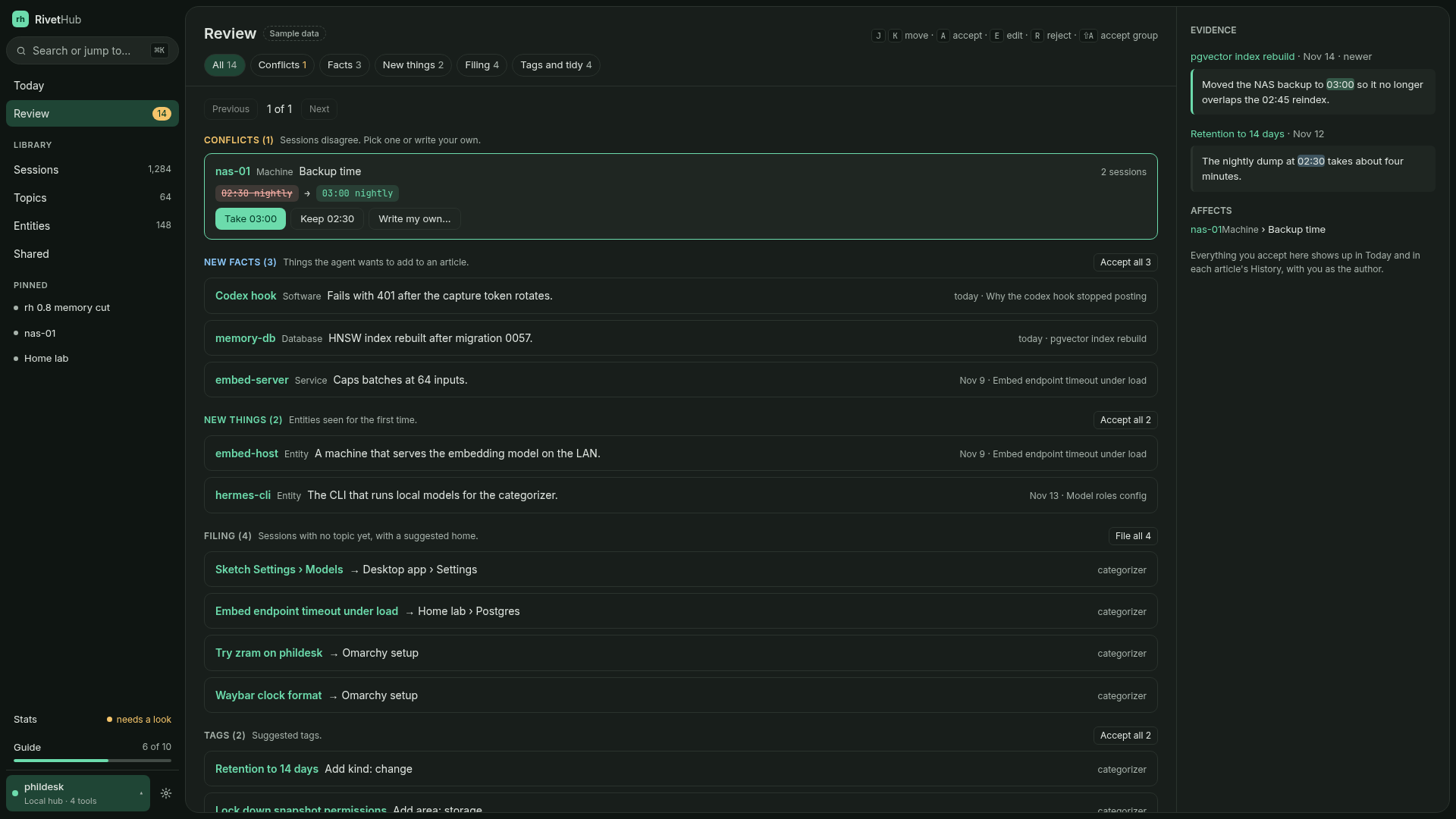
Changes to the shape of your memory (merging two topics, moving one, renaming, closing, deleting, creating a topic or a type) wait as Tidy proposals until a person approves or rejects them. Today proposals are reviewed through the node's API (/api/tidy/proposals), and will appear in the desktop app once it releases. Deleted sessions move to trash first.
Recall over MCP: any agent can ask
rh mcp serves your memory to any MCP client, over stdio or over HTTP with a bearer token. rh harness connect adds this entry for you.
{ "mcpServers": { "rivethub": { "command": "rh", "args": ["mcp"] } } }memory_search- Hybrid, keyword, fuzzy, regex or vector search, with date filters.
memory_browse- Messages in time order, by day or by session.
memory_get_full- The full text of a result that search shortened.
memory_stats,memory_tags- What is stored and how it is labeled.
wiki_search,wiki_read- The topic and entity pages.
Export and move: the record goes where you go
rh memory export writes a store out and rh memory import reads one in. rh memory merge-store folds one Postgres store into another in a single transaction. rh memory bundle packages chosen sessions for another RivetHub to ingest, and rh memory sanitize scrubs secrets from a bundle and writes a report of every change before it leaves your machine.
On one machine the whole record is a single SQLite file you can copy.
Models: bring your own, or none
Nothing is required to start. Capture and keyword search need no model. Add an embedding endpoint for semantic search, and a chat model for summaries, filing and the wiki. Any OpenAI-compatible endpoint works, local or hosted, and the model you choose is the only thing outside your node that sees session text. Jobs wait, they do not fail, while a model server is unreachable.
The setup guide has the config.
The 46-second overview
rh 0.8.See it with your own sessions.
Three steps to a first captured session, with no model and no account.