The stable distribution of RivetOS
Your own mesh of AI agents, on your own hardware.
RivetHub is the stable distribution of RivetOS — a mesh of agent nodes plus a central datahub, with harness-agnostic conversation capture and recall. It ships pinned releases and short, readable install scripts.
# on the host that will be your hub:
$ sudo bash install/datahub.sh --advertise-host 192.0.2.10
The curl form —
curl -fsSL https://get.rivethub.io/datahub.sh | bash — is
refused in preflight until the helper files are published. A checkout is
the path that works today; the datahub
guide explains why.
RIVETOS_SHARED_DIR (default
/var/lib/rivethub/shared); the datahub stays the source of
truth for mesh.json and the CA.// how it works
Three steps to your own mesh
One datahub, any number of agent nodes, and whatever client you already talk to. Enrollment and sync happen over SSH; node-to-node traffic is mTLS.
-
Install the datahub
One host runs Postgres 16 + pgvector, the memory schema, and the mesh certificate authority. The CA root key never leaves that host.
Full datahub guide →$ sudo bash install/datahub.sh --advertise-host 192.0.2.10 -
Install an agent node
Each node enrolls against the datahub over SSH and gets a mesh certificate — node-to-node traffic is mTLS on mesh port 3000. The installer runs as root, so BatchMode SSH uses
/root/.ssh— copy your key there first.Full node guide →$ curl -fsSL https://get.rivethub.io/node.sh | bash -s -- --hub owner@192.0.2.10 -
Chat
Point the node at a model provider and a channel — Telegram, Discord, a CLI front-end — and start talking to your agent. The runtime, its config schema, and channel setup are documented at rivetos.dev; this site only covers the distribution and installers.
rivetos.dev →
// what you get
Built for operators, not demos
-
Memory, captured and recalled
Conversations are captured into Postgres 16 + pgvector on your own datahub. Semantic recall comes from the optional embedder and compactor workers — off by default (
--memory lite), one flag away (--memory full). -
Mesh delegation
Nodes enroll over SSH and identify each other by certificate. Node-to-node traffic is mTLS on mesh port 3000, and
mesh.jsonon the datahub is the shared source of truth for who is who. -
Harness-agnostic
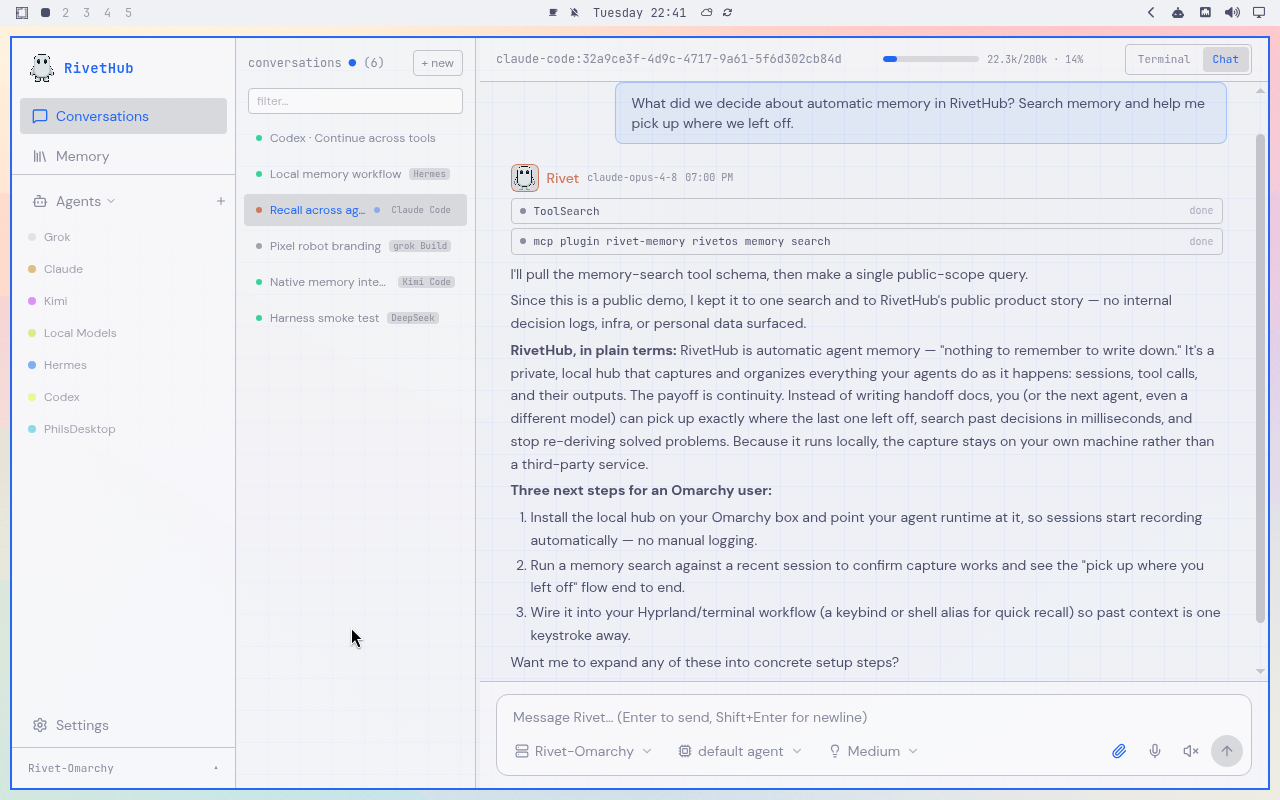
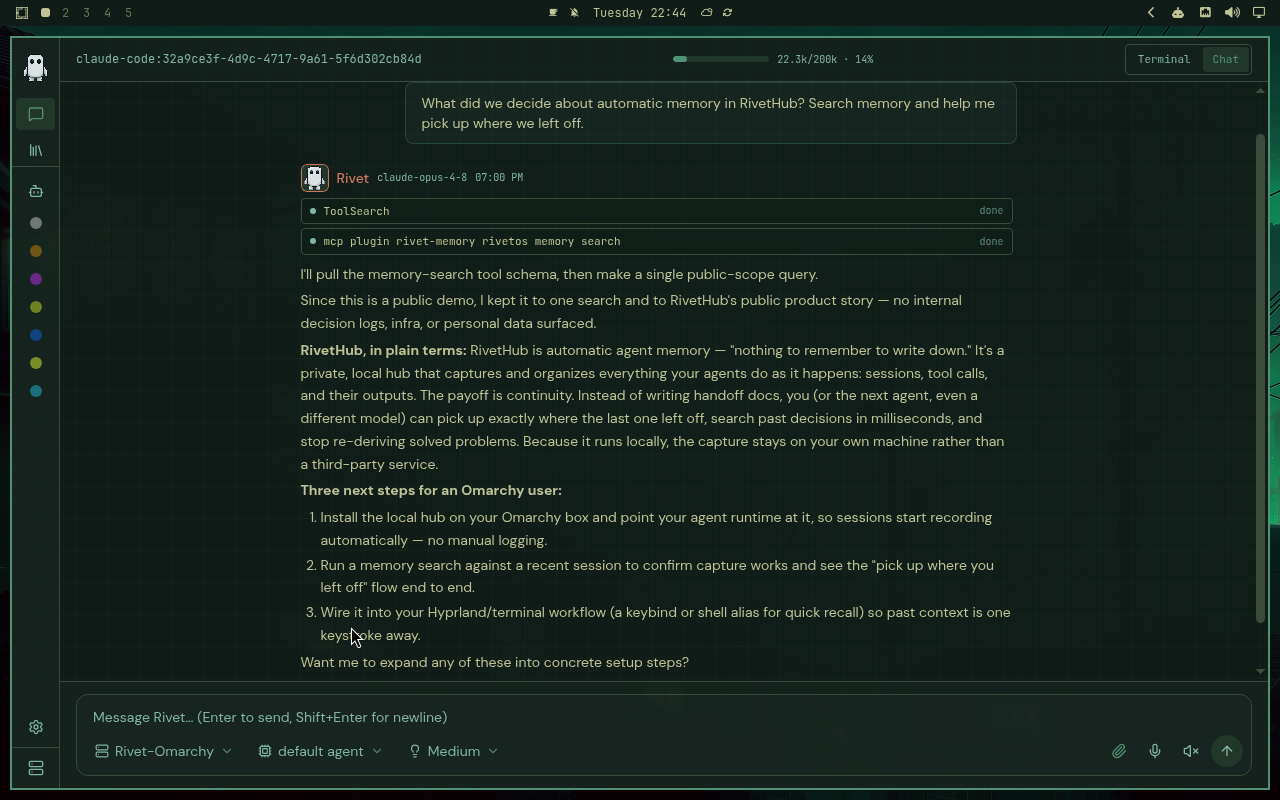
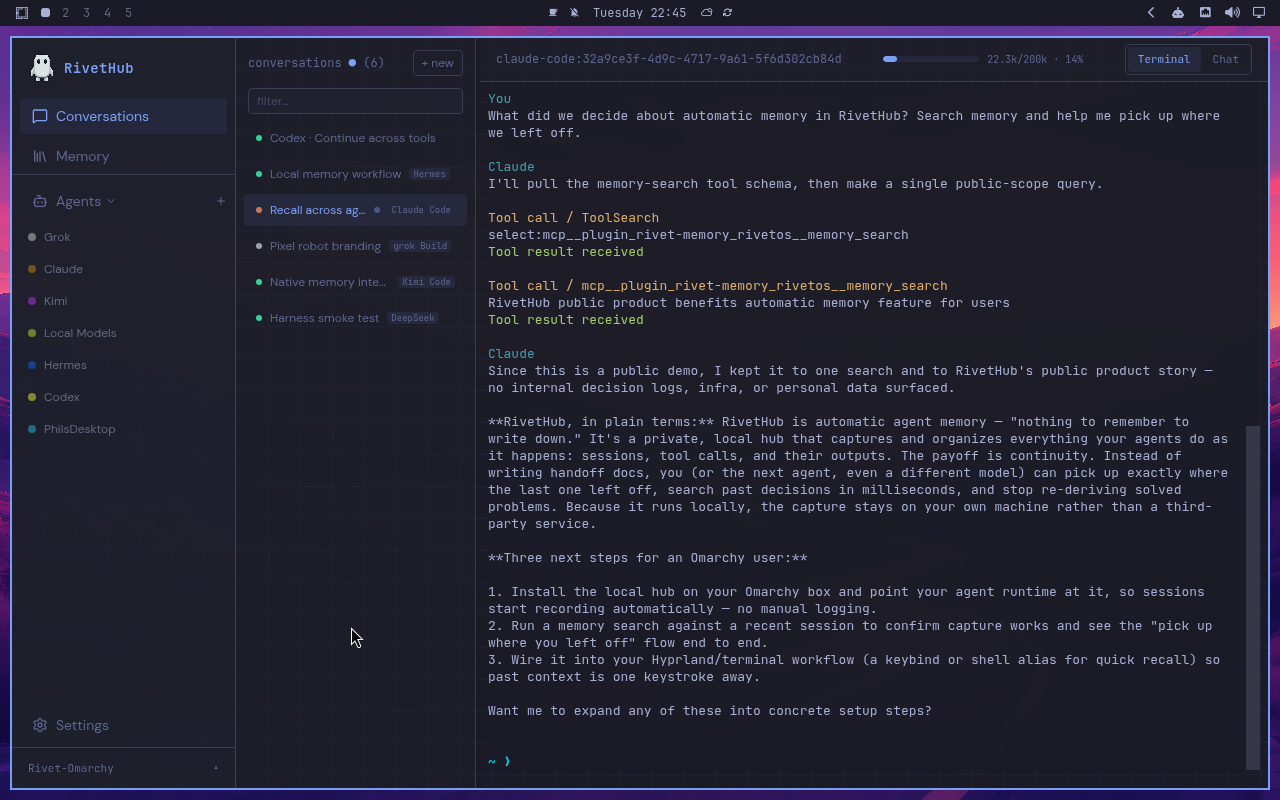
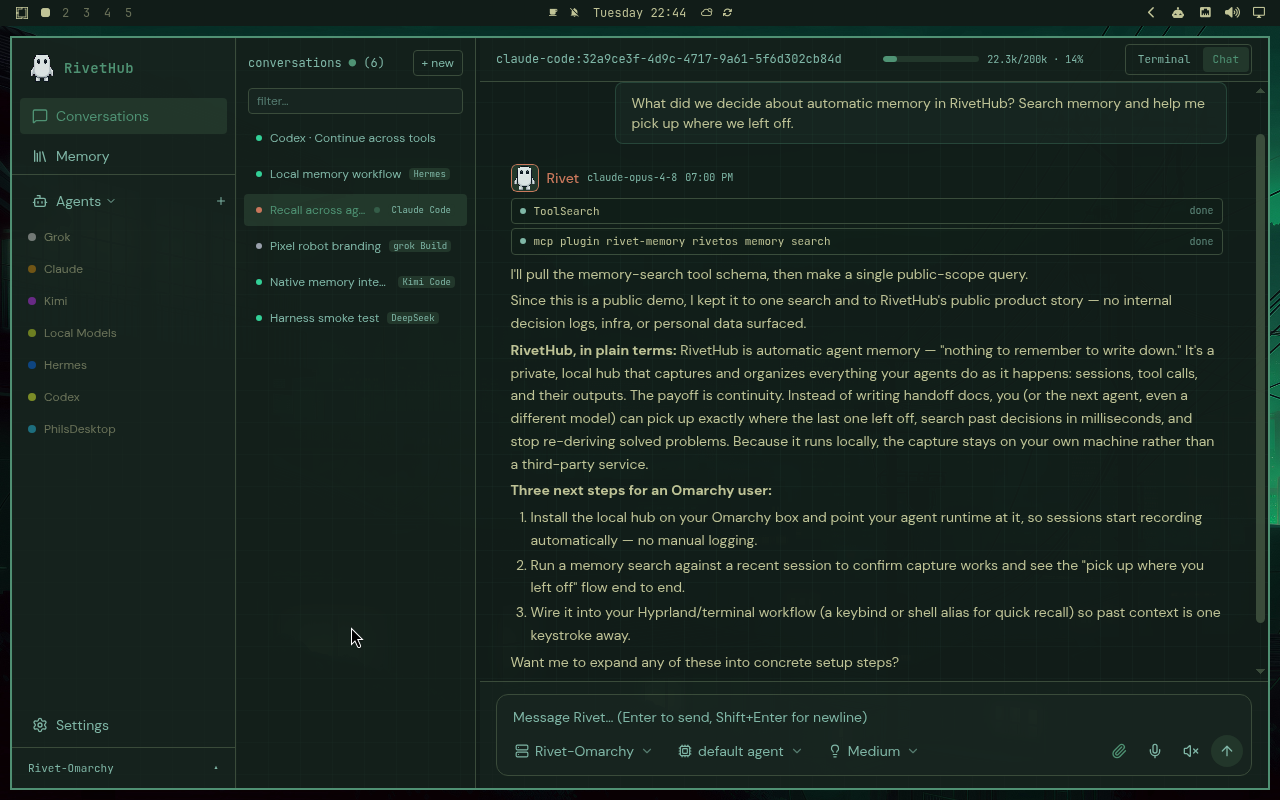
The capture pipeline sits below the agent harness, so history is captured and recalled the same way whichever front-end you run. No per-harness plugins, no lock-in to one vendor's memory.
-
Bring your own model
Point each node at any model provider; memory workers take OpenAI-compatible embed and compaction endpoints. There is no RivetHub-run control plane — nothing phones home.
// honest status
Honest status
RivetHub is built for people comfortable running their own Debian/Ubuntu servers. A few things to know up front:
- The release channel is not pinned yet — every pin
in
pins/stable.jsonis still anUNPINNEDplaceholder, so clones and images float until the first real stable tag. See Releases. install/datahub.shcurl-pipe is refused until the helper files are published; run it from a checkout.rivetos mesh enrollis not merged upstream yet — the node installer implements the same tarball contract over SSH today.- Memory workers (embedder / compactor) are off by default
(
--memory lite).
Read the scripts first.
Curl-pipe installers should be boring. Both install scripts are short, free of hidden control flow, and meant to be read before they are run — the same posture the rest of the distribution follows. Nothing here phones home; the CA root key never leaves the datahub.